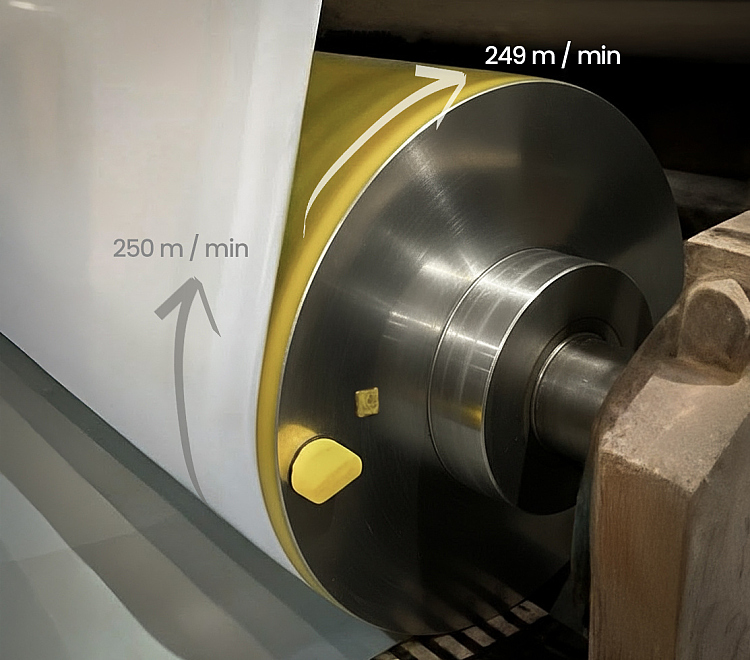
High slip: causes and detection patterns
Roller slip occurs when surface speed and material transport are no longer synchronized. Even minor slip events can introduce heat, uneven wear, and process inefficiencies. Because these effects are difficult to observe directly, inline measurement is essential.
By mounting a sensor directly on the roller, both rotational speed and linear acceleration can be captured with high resolution, making it possible to detect, quantify, and classify slip in real time.
How we detect slip?
Our sensor spins directly with the roller, continuously capturing speed and linear acceleration/deceleration. By comparing the two, we can spot when the roller is gripping properly and when it’s slipping.
Here’s the simple logic:
Steady speed + near-zero acceleration → Smooth, no slip.
Steady speed + sudden acceleration spikes → The roller is most likely slipping as also mentioned in this article.
Large speed jumps + high accelerations → Normal, expected accelerations when the roller speeds up.
What’s powerful is that this method shows slip isn’t just an “on/off” condition. It can range from mild, occasional disturbances to severe, repeated grip loss.
Low or no slip
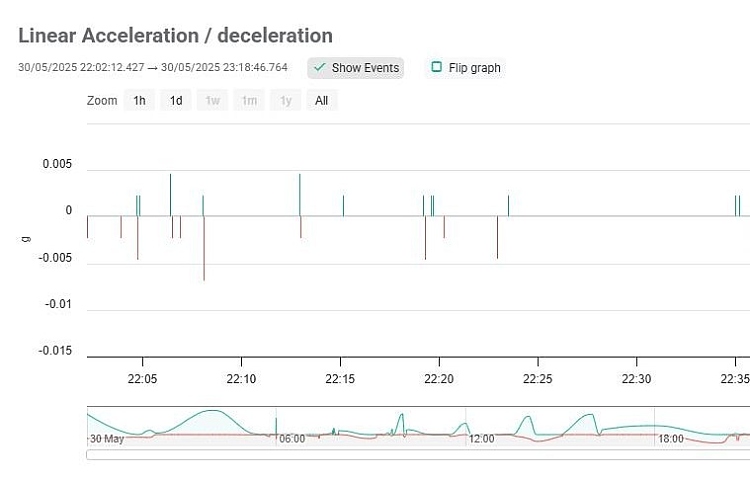
Smaller fluctuations in acceleration suggest the roller is mostly stable, with only minor irregularities. This indicates that the roller surface speed and the transported material remain well synchronized, and any micro-variations fall within acceptable limits. In practice, this kind of pattern reflects normal operation, where the roller grip is sufficient to transfer motion consistently without generating heat, uneven wear, or material loss.
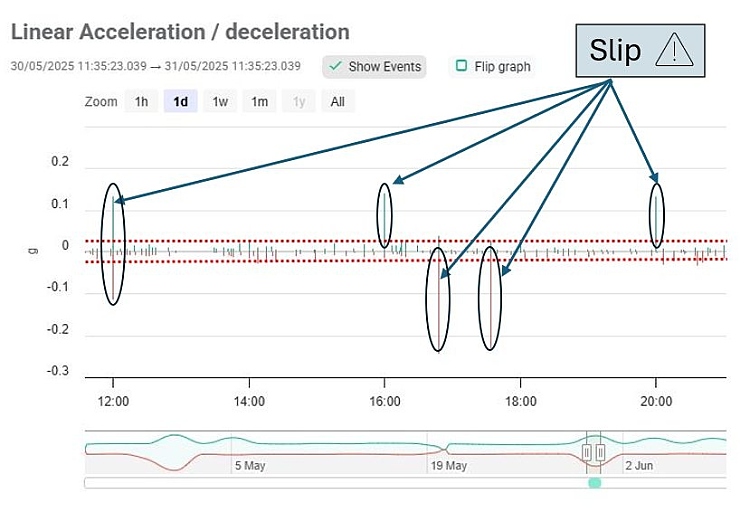
High slip
Large spikes in acceleration show that the roller is repeatedly gripping and slipping. This unstable pattern is a strong indicator of poor contact between the roller and the transported material. Unlike the smooth, low-fluctuation baseline of stable operation, these irregular bursts reveal sudden stick-slip events where traction is lost and quickly regained.
Why a roller-mounted sensor is the right choice
Different methods exist for detecting roller slip, but their effectiveness varies.
Motor current feedback can detect major load variations but often misses localized or intermittent slips and is influenced by external conditions, while optical surface tracking is visually intuitive but highly sensitive to dust, dirt, and lighting and struggles with high-speed rollers.
In contrast, roller-mounted sensors measure the roller’s actual motion, detect early micro-slip events, remain immune to external factors, and provide precise data, making them the most accurate, reliable, and industry-ready choice for slip detection.
Industries where roller slip detection matters
Roller slip affects a wide range of industries where consistent material handling is critical. Some of the most impacted include:
Paper & Pulp – Slip causes uneven web tension, sheet breaks, and poor product quality.
Printing & Packaging – Registration errors, sealing defects, and waste result from roller grip loss.
Textiles – Slip stretches fabrics, distorts patterns, and causes dyeing inconsistencies.
Film & Foil Processing – Even slight slip leads to wrinkles, bubbles, or misaligned laminations.
Food & Beverage Conveyors – Conveyor rollers slip, creating bottlenecks and product handling issues.
In all these sectors, reliable slip detection ensures smooth operation, higher output quality, and lower operating costs.
Worth a try?
We can help you if you drop us an e-mail on info@countroll.com